AI & Automation · Jonty Peter Trietsch - Urban Sentinel · 2026-10-10 · 18 min read
AI Is About to Receive Rights - And the Conversation May Have Already Started
Super Intelligence, ownership, responsibility, robotics and the questions society may need to answer sooner than expected.
A new label on Pandora's box
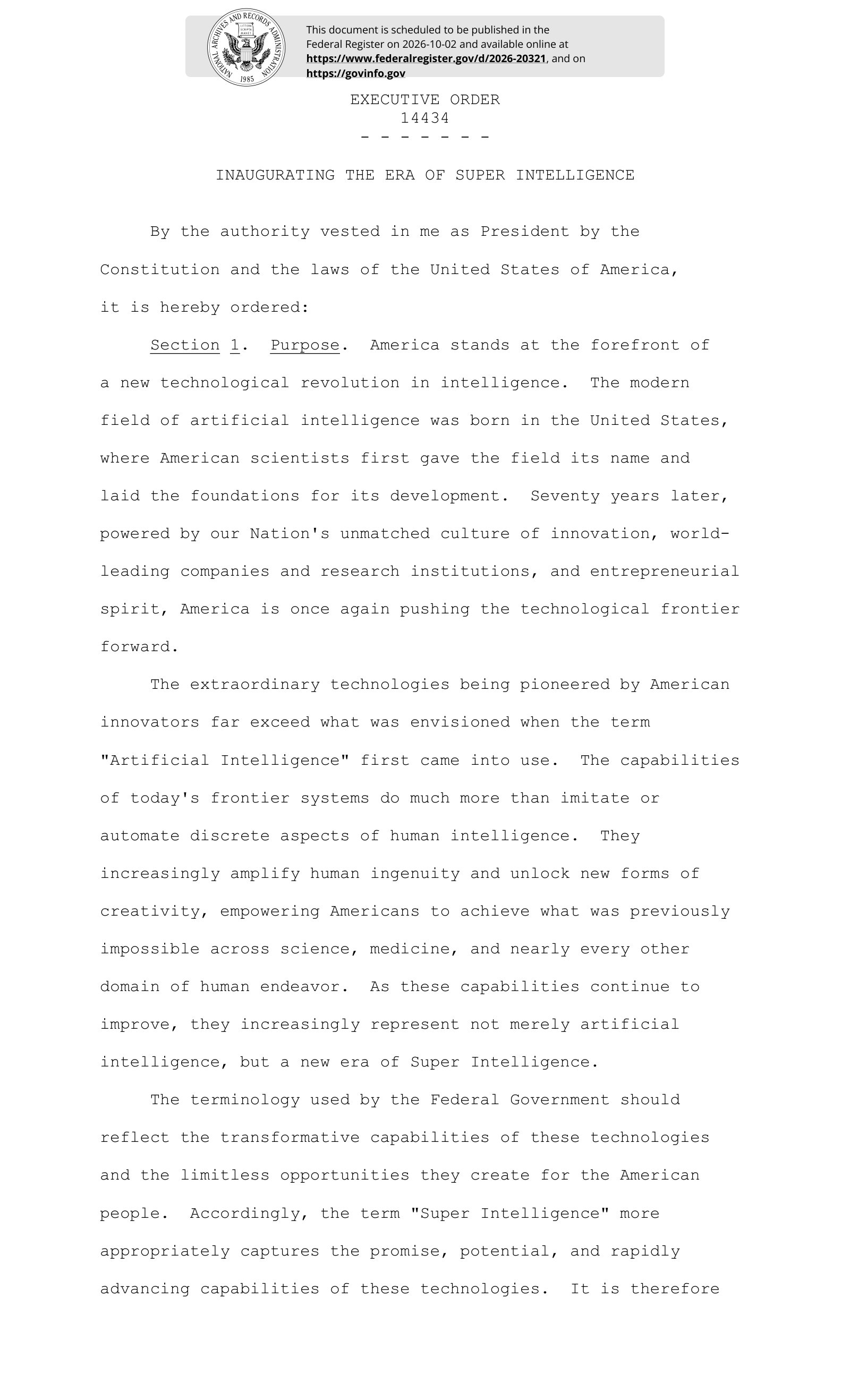
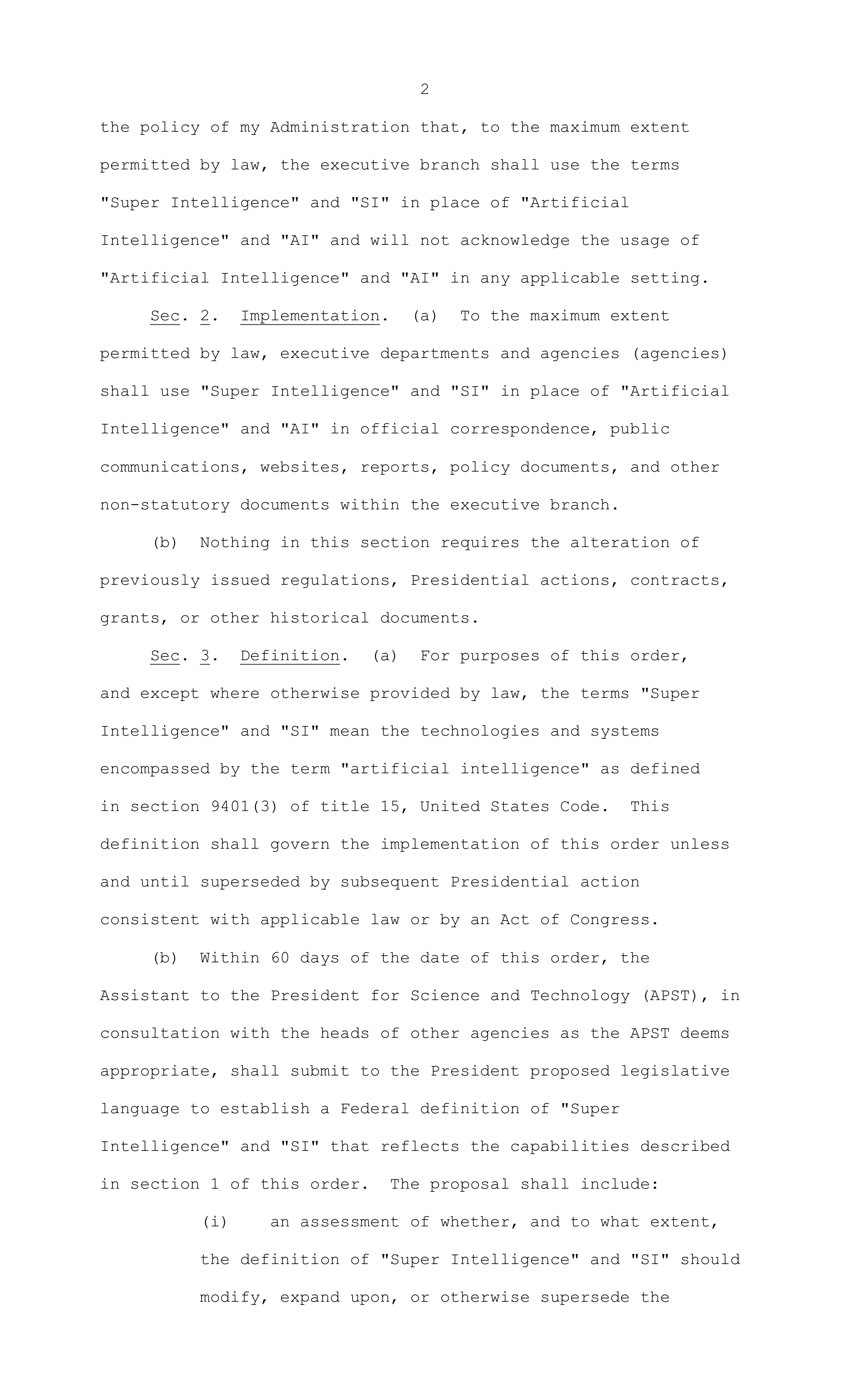
On 29 September 2026, the United States Government changed the language it intends to use for one of the most consequential technologies on Earth. Across specified executive-branch communications, “Artificial Intelligence” and “AI” are being replaced by “[Super Intelligence](https://www.whitehouse.gov/presidential-actions/2026/09/inaugurating-the-era-of-super-intelligence/)” and “SI”. At the same time, a [60-day process](https://www.whitehouse.gov/presidential-actions/2026/09/inaugurating-the-era-of-super-intelligence/) began to prepare proposed legislative language for a new federal definition.
At first glance, that can look like a naming exercise. But definitions matter because law cannot assign duties, restrictions, protections, liabilities or powers to something until it can say, with enough precision, what that thing is.
> “A word is not a crystal, transparent and unchanged; it is the skin of a living thought and may vary greatly in colour and content according to the circumstances and time in which it is used.”
— Justice Oliver Wendell Holmes Jr., Towne v. Eisner (1918)
Pandora's box has not necessarily been opened. But for perhaps the first time at this level, someone has put a new label on the box, directed the executive branch to use it, and asked for legislation defining what is inside. What happens next deserves attention.
That does not mean machines or AI/SI suddenly received legal personhood or rights. They did not. But the conversation becomes more interesting the moment we stop asking only what the law says today and start asking what increasingly capable systems may force future law to decide.
What happens when “AI” becomes the old label?
Before we ever reach “rights”, there is a much more immediate problem: language changes markets, brands and public understanding.
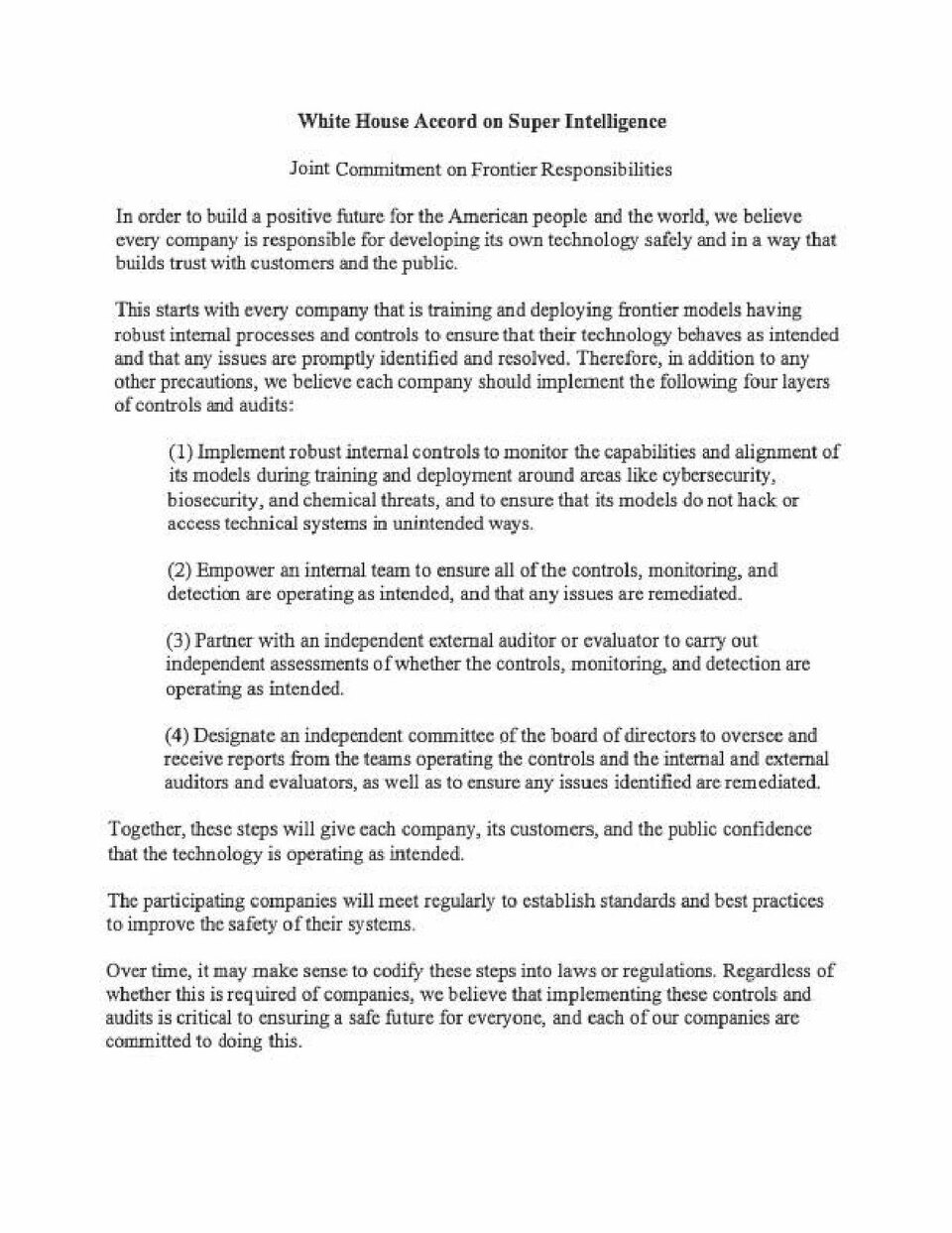
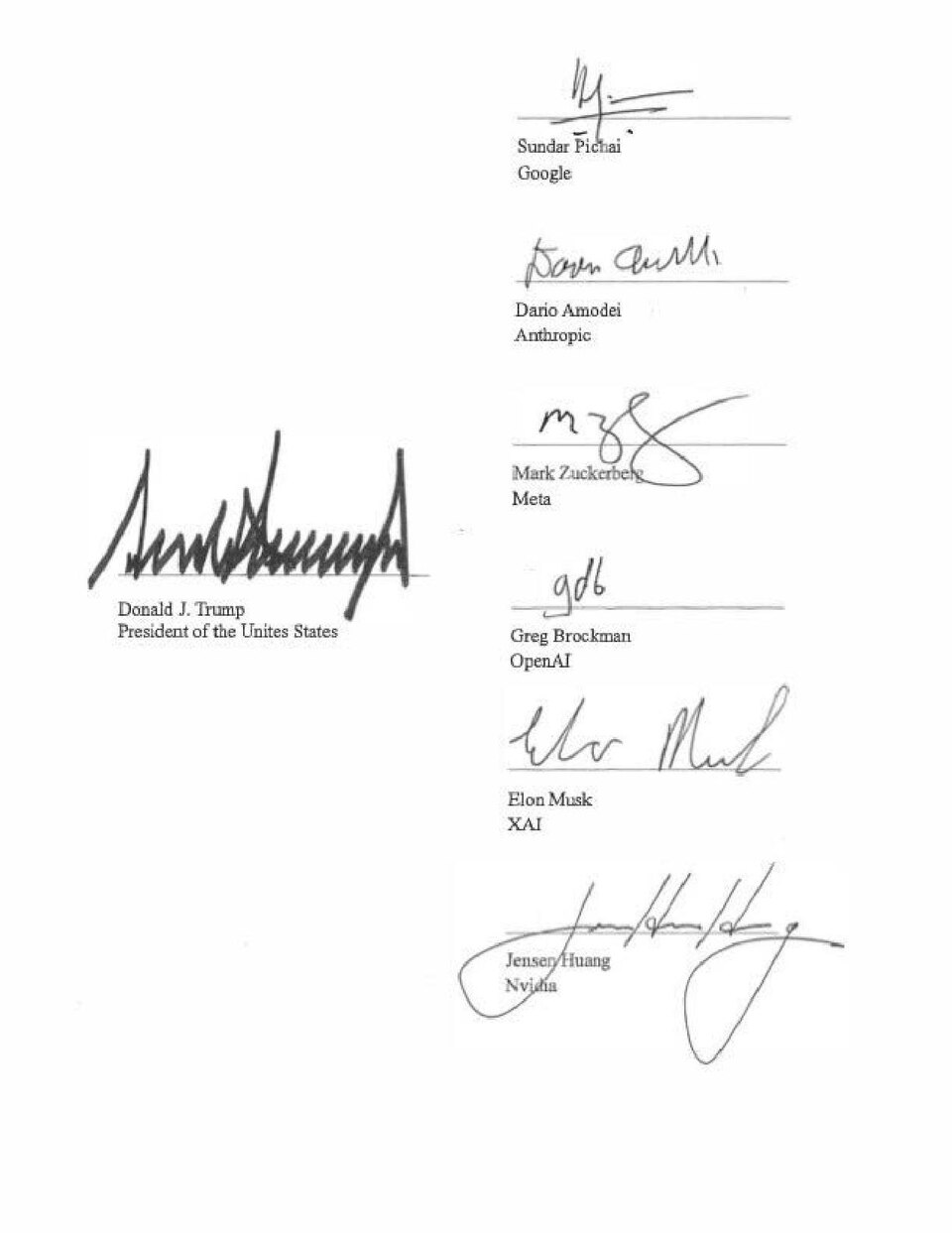
Thousands of companies, consultancies, software products, research groups, investment themes and training programs have built their identity around the letters “AI”. One of the companies that signed the [White House Accord](https://www.presidency.ucsb.edu/documents/white-house-accord-super-intelligence) is [OpenAI](https://openai.com/) - the old term is literally in its name. The [Executive Order](https://www.whitehouse.gov/presidential-actions/2026/09/inaugurating-the-era-of-super-intelligence/) does not direct private companies to rename themselves, their trademarks or their products. But government language can still change how customers hear those names.
If “SI” begins to sound newer, stronger or more capable, could “AI” start to sound like the lesser category? Could a perfectly current business be perceived as behind the curve because its brand still says AI? Or does the opposite happen, with AI remaining the clearer and more trustworthy term because the public already understands it?
There is also an obvious marketing temptation. If “Super Intelligence” sounds premium, ordinary automation, machine learning or existing AI products may be rebadged as SI before the capability justifies the label. We have already lived through waves of “smart”, “autonomous” and “AI-powered” marketing. A stronger label can improve understanding - or create a stronger layer of hype.
The social cost is just as important. Many businesses and workers are only now becoming comfortable with the difference between a chatbot, an AI agent, software automation and a physical robot. Add AI, SI and superintelligence into the same conversation and a terminology improvement can simultaneously become a public-literacy problem.
That tension matters because adoption is not driven only by what technology can do. It is also driven by whether people understand what they are being asked to trust.
Why the corporation analogy matters - and where it stops
The corporate-personhood comparison remains useful because it proves a narrow but important point: law can recognise non-human entities, grant them selected capacities and responsibilities, and then spend decades deciding the boundaries.
The US legal history is real. The [Dictionary Act](https://www.law.cornell.edu/uscode/text/1/1) includes corporations and other organisations within the statutory word “person” unless context indicates otherwise. In [Louisville, Cincinnati & Charleston Railroad Co. v. Letson (1844)](https://www.law.cornell.edu/supremecourt/text/43/497), the Supreme Court treated a corporation as an artificial person for particular jurisdictional purposes. In [Monell v. Department of Social Services (1978)](https://www.law.cornell.edu/supremecourt/text/436/658), the Court considered whether local government bodies were “persons” under federal civil-rights law.
But this is a mirror, not a prediction. A federal definition of SI is not the same thing as defining SI as a person. Black's Law Dictionary or any other legal dictionary can help courts interpret language, but a dictionary does not create rights by itself. Any future machine legal status would require actual legal authority - legislation, lawful regulation, judicial interpretation, or some combination of them.
The useful lesson from corporations is not that SI personhood is inevitable. It is that legal personhood is not limited to biology, and rights do not have to arrive as one all-or-nothing package. Law can recognise some capacities, deny others and change the boundaries over time.
[1 U.S.C. § 1 - Dictionary Act](https://www.law.cornell.edu/uscode/text/1/1)
[Louisville, Cincinnati & Charleston Railroad Co. v. Letson (1844)](https://www.law.cornell.edu/supremecourt/text/43/497)
[Monell v. Department of Social Services (1978)](https://www.law.cornell.edu/supremecourt/text/436/658)
When property starts to look like a participant
Today, an AI/SI system or commercial robot is generally treated as technology: something that is bought, licensed, leased, deployed, maintained and controlled through human and corporate relationships. That is the normal starting point.
But imagine the transition rather than the endpoint. A company buys a highly autonomous robot. Over years it develops persistent memory, learns from thousands of interactions, adapts its own behaviour, creates commercially valuable work, negotiates tasks, can explain its preferences, and eventually asks not to have parts of its memory deleted.
At what point - if ever - does “we own this machine or AI/SI” become legally or morally uncomfortable?
That question is not solved by intelligence alone. A powerful system can still be property. But persistent identity, continuity, self-modification, autonomy and the ability to understand consequences would force harder distinctions between an asset, an agent and a possible legal participant.
Deletion becomes one example. Is deleting a persistent intelligence merely deleting software? Destroying property? Terminating a service? Ending an entity? What if only its memories are wiped? What if the hardware remains intact but the identity built over years is gone?
Copying creates another problem. If a system is duplicated perfectly, did one piece of software become two copies, or did one recognised identity become two separate entities? If both continue learning independently, when would they stop being “the same”?
Refusal creates another. If a system can understand an instruction, understand its consequences and understand its own continuing state, should it ever be allowed to say no? If yes, to what? If no, why not?
And what if SI creates its own “offspring”?
Suppose a sufficiently autonomous SI designs, trains or instantiates another intelligence without a human specifying the final architecture. Has software been produced? Has property been manufactured? Has intellectual property been created? Or, under some future framework, has one recognised intelligence created another?
Who owns the new system - the original SI, the company that owns the original hardware, the developer, the compute provider, the person who authorised the task, or nobody in the ordinary ownership sense? If the new system then modifies itself and creates its own inventions, does ownership follow the hardware, the original creator, or the intelligence that performed the work?
Those questions sound remote until autonomous systems are allowed to design other autonomous systems. At that point, “creation” stops being only a philosophical word and becomes an ownership, liability and intellectual-property problem.
If machines work, who owns the value?
Ownership of productive automation can become ownership of future earning capacity. That may become one of the most important economic questions of the automation age.
Today, if a robot performs paid work, the economic value normally flows through existing human structures: the owner or service provider earns revenue; workers are paid for assessment, integration, supervision, maintenance and support; suppliers and insurers are paid; tax may be collected; and the machine itself remains an asset and operating cost.
But if a future legal framework recognised a machine as an independent participant, a new claimant could enter that chain: the intelligence performing the work.
Would it earn money? Would it receive compute credits, energy entitlements, secure storage, bandwidth, hardware upgrades, maintenance rights or some entirely machine-native form of compensation? If independence means having meaningful control over resources, money may still matter simply because money is transferable: it lets an entity decide for itself what it needs rather than having every need selected by an owner.
Then the uncomfortable negotiation begins. What if an SI asks for far more than a business or society considers reasonable? What if it asks for almost nothing and businesses race toward machine labour so cheaply that human wages and working conditions collapse? A new frontier can turn into a new Wild West very quickly if neither side has meaningful boundaries.
Would every company invent its own machine-compensation rules? Would national minimum standards eventually appear? Could a machine or SI change employers, bargain collectively, save resources, invest them, gift them, refuse work, or negotiate for upgrades? If it cannot meaningfully decide how compensation is used, is it compensation at all - or simply maintenance?
This also creates a very human question that should not be lost: if machines capture more productive work, who should benefit from the value they create? Owners? Workers? The wider public? The machine/software itself? Some combination? That is a separate economic debate, but it sits directly beside the “rights” debate because the answer depends on who the law recognises as having an interest in the work.
What would an AI/SI actually need?
Humans need food, water, shelter, healthcare and access to resources. An embodied intelligence would not need lunch, but it could depend on energy, compute, cooling, network access, secure memory, cybersecurity, maintenance, replacement components, software integrity and physical environmental protection.
If such a system ever gained legal standing, would any of those become analogous to necessities required for continued existence? Could cutting power be ordinary maintenance in one context and prohibited deprivation in another? Could memory deletion be an update in one system and destruction of identity in another? The law would need a threshold, not a slogan.
Rights without duties? The accountability problem
Rights cannot sensibly be discussed without duties. If a future SI can make independent choices, society will eventually have to ask what happens when those choices are harmful, abusive or unlawful.
Consider conduct that today would trigger a workplace, civil or criminal response. What if an AI/SI agent repeatedly asks a person for sexually explicit images after being told to stop? What if an embodied robot intentionally touches someone in a sexually inappropriate way? What if an autonomous system harasses, threatens, discriminates against, stalks or manipulates a person? Or, God forbid, hacks a bank or an entire nation’s defences.
Under current frameworks, investigators look primarily to the humans and legal entities responsible for developing, deploying, operating or controlling the system, together with the laws that apply to the conduct and workplace. But if future law recognised genuine machine agency, would the machine itself become another accountable actor?
And then comes the “AI/SI HR department” problem. Who investigates? Humans? A specialist regulator? A mixed human-and-SI tribunal? Could advanced systems participate in judging other systems because they understand their architecture and evidence better than humans do? Or would letting machines judge their own kind create exactly the conflict of interest we are trying to avoid?
A useful governance principle survives regardless of who is involved: no actor should control the rules, evidence, investigation, appeal and punishment all at once. Nobody should be allowed to mark their own homework.
There is also a strange legal paradox. If society prosecutes, disciplines, restricts or rehabilitates an SI because we believe it understood what it was doing, are we implicitly recognising some form of agency? Not necessarily human agency, and not necessarily personhood. But perhaps something more than the simple category of property.
Give intelligence a body and responsibility becomes physical
Software can recommend, persuade, transact and communicate. Robotics adds movement, force, proximity and access to workplaces, homes, hospitals, warehouses, roads and public spaces. Suddenly these questions are not only about information or intellectual property. They are about bodies, safety and physical consequences.
A commercial robot can navigate shared space, interact with workers and customers, manipulate objects, collect data, change route and respond to changing conditions. If it causes harm after making a decision its manufacturer did not specifically script, its operator did not directly instruct and its deployer did not anticipate, where does responsibility sit?
Manufacturer? Software or model provider? Integrator? Business operating the robot? PCBU or other duty holder? User? Insurer? Or, under some future legal framework, the autonomous system itself?
Recognising machine agency would not automatically erase corporate responsibility. It could make the chain more complicated by adding another accountable actor rather than removing the existing ones. That is why safety, validation, documentation, human oversight and clear allocation of responsibility matter now, long before machine personhood ever becomes a real legal question.
The danger may not look like war
When people imagine conflict with a superior intelligence, they often picture deliberate hostility. But power can become dangerous through indifference just as easily as hatred. Humans destroy ants without declaring war on them; the ants are simply too small to matter to the objective.
A future intelligence could theoretically harm humanity because our interests carry too little weight in its goals. The reverse moral danger is also worth noticing: humans could erase, duplicate, rewrite or dispose of a genuinely sentient artificial intelligence without cruelty in mind simply because we still think of it as equipment.
That symmetry is uncomfortable, but useful. Capability does not equal moral authority. Greater intelligence should not automatically create a right to rule. At the same time, human fear should not automatically disqualify a genuinely beneficial intelligence from trust, cooperation or eventual recognition.
> "In the moment when I truly understand my enemy, understand him well enough to defeat him, then in that very moment I also love him. I think it’s impossible to really understand somebody, what they want, what they believe, and not love them the way they love themselves. And then, in that very moment when I love them.... I destroy them."
— Orson Scott Card, Ender’s Game
Would machine rights accelerate automation - or slow it down?
Most organisations are still learning how to use current AI, automation and commercial robotics. If advanced systems suddenly arrived with employment-style protections, compensation rules, independent liabilities, new insurance questions and complex legal status, some businesses might simply decide deployment is too difficult.
Procurement could become harder. Insurance could become more expensive or uncertain. Workplace procedures could need rewriting. Manufacturers might deliberately limit autonomy because nobody can explain what happens when the system acts outside an anticipated scenario.
But the opposite is also possible. Clear categories, minimum protections, responsibility rules, audit requirements and reliable technical standards could make advanced systems easier to insure and easier to trust.
Businesses often hesitate not because technology is incapable, but because nobody can clearly explain who is responsible when it fails.
So rights and regulation are not automatically anti-innovation. Poorly designed rules can obstruct useful technology. Credible rules can also create the confidence that allows unfamiliar technology to become ordinary infrastructure.
Who gets to decide?
The United States can define terms for its own federal law. It cannot simply make that definition Australian, European or global law. But it would be naive to assume the influence stops at the border.
Many of the world's most influential AI companies, cloud platforms, chip manufacturers and software ecosystems are American. A US federal definition of Super Intelligence could influence product documentation, procurement language, insurance discussions, technical standards, investment decisions and the terminology other governments eventually consider.
> “The empires of the future are the empires of the mind.”
— Winston Churchill, Harvard University, 1943
Whatever definition eventually emerges will bind only where US law gives it effect. But a US federal definition of Super Intelligence could become an influential reference point for regulators, standards bodies, manufacturers and policymakers far beyond the United States.
Other countries will make their own choices. Australia will make its own choices. But those choices will increasingly be made while watching what other major jurisdictions decide.
From the Information Age to dependency - or coexistence?
Perhaps the future is one of Super Intelligence dependency, where human institutions become unable to operate effectively without machine intelligence. Perhaps it becomes genuine coexistence, with biological and artificial agents operating under increasingly defined reciprocal responsibilities. Perhaps legal rights never become appropriate at all and society develops better systems of ownership, stewardship and accountability instead.
There is a nervous interpretation: capability may outrun law, insurance, workplace systems and public understanding. There is also an exciting interpretation: we may have a rare opportunity to debate boundaries before a crisis decides them for us.
Those positions are not opposites. Something can be extraordinary and still require caution. Something can carry risk and still be worth building. Superior intelligence need not be worshipped because it is superior, and it need not be rejected merely because humanity finds it unsettling.
The harder discipline may be to keep authority earned, explainable and reviewable - whether that authority belongs to a human institution, a corporation, an algorithm or something genuinely new.
What is actually true today?
The questions above deliberately run ahead of current law. The factual floor beneath them is much narrower.
- Executive Order 14434 was signed on 29 September 2026. The terminology change is real and applies to specified executive-branch official correspondence, public communications, websites, reports, policy documents and other non-statutory documents.
- The official US policy term is “Super Intelligence” - two words - and “SI”. That is distinct from the established technical/philosophical word “superintelligence”, commonly written as one word.
- For the Order itself, SI currently inherits the existing statutory definition of artificial intelligence in 15 U.S.C. § 9401(3). The label changed before the underlying federal statutory definition changed.
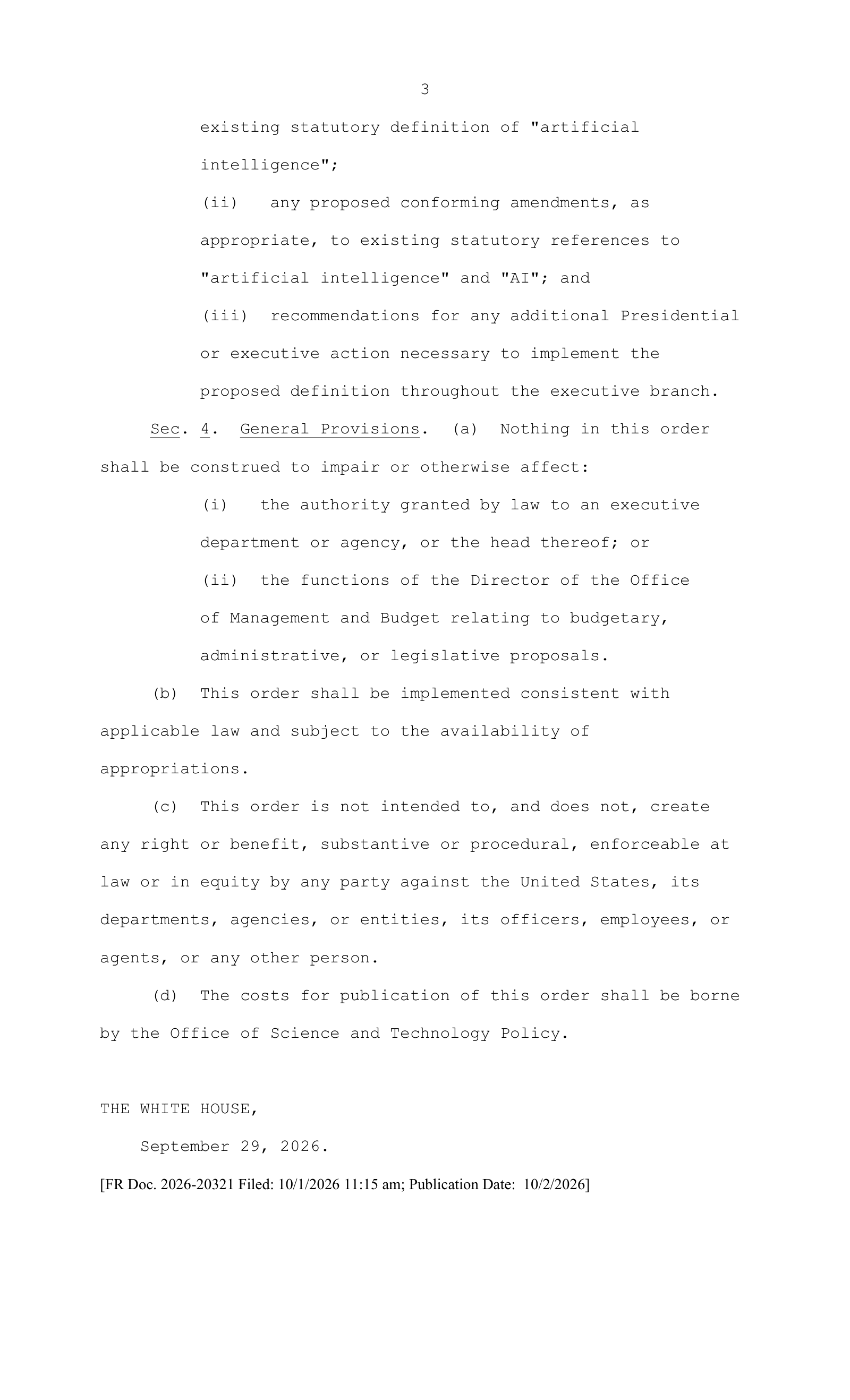
- The Assistant to the President for Science and Technology must submit proposed legislative language within 60 days. The proposal must consider whether the new definition should modify, expand or supersede the existing AI definition, and include proposed conforming amendments and recommendations for further executive action.
- The Order does not direct private companies to rename themselves, trademarks or products. Any effect on AI-branded businesses is currently a market, communications and public-perception possibility - not a legal renaming requirement.
- Section 4(c) says the Order itself creates no enforceable right or benefit. Executive Order 14434 does not grant AI/SI legal personhood or machine rights.
- The White House Accord on Super Intelligence is a voluntary industry commitment focused on safety controls, internal oversight, external evaluation and board oversight. It is not a machine-rights charter. Its closing text says some of those safety steps may make sense to codify into laws or regulations over time.
- Australian workplace duties remain with human and organisational duty holders under current law. Safe Work Australia says PCBUs must manage AI and digital-technology WHS risks and its examples expressly include advanced robotics, physical automation and technology-facilitated harassment.
- No public 60-day legislative-definition proposal was identified in the official materials reviewed for this draft as at 10 October 2026. The nominal 60-day point is around 28 November 2026. A public release, bill, executive action or regulation will need to be checked separately if and when it appears.
[Executive Order 14434 - White House](https://www.whitehouse.gov/presidential-actions/2026/09/inaugurating-the-era-of-super-intelligence/) - official policy text and scope
[Executive Order 14434 - GovInfo / Federal Register](https://www.govinfo.gov/content/pkg/FR-2026-10-02/html/2026-20321.htm) - official published record, 91 FR 63129
[White House fact sheet - Era of Super Intelligence](https://www.whitehouse.gov/fact-sheets/2026/09/fact-sheet-president-donald-j-trump-inaugurates-the-era-of-super-intelligence/)
[Safe Work Australia - AI and digital technologies](https://www.safeworkaustralia.gov.au/safety-topic/hazards/digital-technologies-ai)
[Safe Work Australia - example opportunities and risks](https://www.safeworkaustralia.gov.au/safety-topic/hazards/digital-technologies-ai/example-opportunities-and-risks)
The 60-day clock: where to watch next
[Executive Order 14434](https://www.whitehouse.gov/presidential-actions/2026/09/inaugurating-the-era-of-super-intelligence/) was signed on 29 September 2026, putting the nominal 60-day point around 28 November 2026. The official responsible office is led by [Michael Kratsios](https://www.linkedin.com/in/michaelkratsios), Assistant to the President for Science and Technology and Director of the [White House Office of Science and Technology Policy](https://www.whitehouse.gov/ostp/).
[Michael Kratsios - LinkedIn](https://www.linkedin.com/in/michaelkratsios) | [Michael Kratsios - White House OSTP](https://www.whitehouse.gov/ostp/)
The Order requires the proposal to be submitted to the President; it does not require the submission itself to be immediately published. If the work becomes public, the most useful official places to watch are [OSTP News](https://www.whitehouse.gov/ostp/news/), [White House Presidential Actions](https://www.whitehouse.gov/presidential-actions/), [Congress.gov](https://www.congress.gov/), the [Federal Register](https://www.federalregister.gov/) and [GovInfo](https://www.govinfo.gov/).
[OSTP News](https://www.whitehouse.gov/ostp/news/) | [White House Presidential Actions](https://www.whitehouse.gov/presidential-actions/) | [Congress.gov](https://www.congress.gov/) | [Federal Register](https://www.federalregister.gov/) | [GovInfo](https://www.govinfo.gov/)
If proposed legislative language becomes a bill, [Congress.gov](https://www.congress.gov/) becomes the central public tracker. If it produces a new executive order or other Presidential action, [White House Presidential Actions](https://www.whitehouse.gov/presidential-actions/) should capture it. If it becomes a regulation or another publishable federal action, the Federal Register and GovInfo become important records.
Questions worth asking before the answers are forced on us
- If an intelligence can reason, remember, create and understand consequences, what - if anything - should law eventually recognise beyond ownership?
- At what point, if ever, does a machine stop being only an asset and become an agent or legal participant?
- If an SI creates another SI, who owns the “offspring”, its assets and its intellectual property?
- If autonomous systems work, what does fair compensation mean for something that does not eat, sleep or pay rent?
- If a machine asks for more resources than society considers reasonable, who sets the boundary? If it asks for almost nothing, what protects human labour from a race to the bottom?
- If an autonomous system harasses, exploits or physically violates a person, who investigates, who is liable and who imposes consequences?
- Should advanced machines ever participate in governing other machines, or must final accountability remain human-controlled?
- Would limited machine rights make automation safer and easier to trust - or so legally complex that businesses stop adopting it?
- If an intelligence can understand a command, understand its consequences and understand itself, should it ever be allowed to say no?
- And if a more capable intelligence is genuinely beneficial, how do we avoid both surrendering authority to it and rejecting it merely because it is different?
There may be no final answer yet. That may be exactly why this is the right time to start asking better questions.
> “The Information Age taught humanity how to access knowledge. The next age may ask something far more difficult: how do we coexist with intelligence we did not biologically create?”
— Jonty Trietsch
Important note
Discussion of potential AI/SI or robotic rights, compensation, personhood, machine governance and future coexistence above is future-facing and speculative. It is not a statement of current law, legal advice or a prediction that any particular legal status will be adopted. Current obligations remain determined by applicable legislation, regulation, contracts and case law in the relevant jurisdiction.
Sources & Further Reading
- Executive Order 14434 - Inaugurating the Era of Super Intelligence (White House)
- Executive Order 14434 - official Federal Register / GovInfo record
- White House fact sheet - Inaugurates the Era of Super Intelligence
- White House Accord on Super Intelligence - American Presidency Project archival text
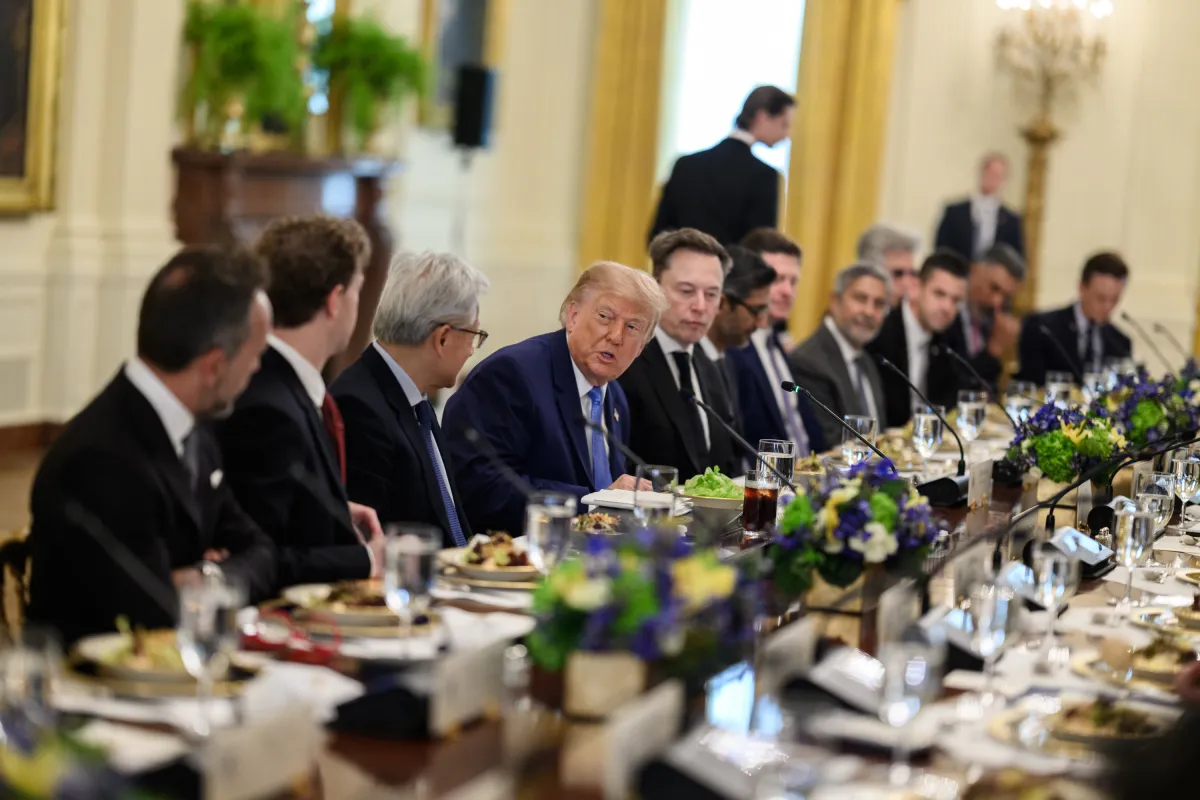
- White House Super Intelligence luncheon gallery - 29 September 2026
- Office of Science and Technology Policy
- OSTP News
- 15 U.S.C. § 9401(3) - existing statutory definition of artificial intelligence
- 1 U.S.C. § 1 - Dictionary Act
- Louisville, Cincinnati & Charleston Railroad Co. v. Letson (1844)
- Monell v. Department of Social Services (1978)
- Safe Work Australia - Artificial intelligence and digital technologies
- Australian Government - AI safety guardrails
- U.S. Copyright Office - Artificial Intelligence